|

 |
| HOME |
_small.jpg) |
| PICTURE OF THE DAY |
 |
| NORTH EUROPEAN SHIPS |
.JPG) |
| SOUTH ATLANTIC AND CARRIBEAN |
 |
| INDIA AND INDIAN OCEAN |
 |
| NORTH AMERICAN SHIPS |
 |
| FAR EAST AND AUSTRALIA |
 |
| MEDITERRANEAN AND MIDDLE EAST |
 |
| ARTICLES AND FEATURES |
 |
| NEWS AND VIEWS |
  |
| PUBLICATIONS |
 |
| WEBCAM |
| |
Seacor Sales
As we trawled though the various
publications we receive for the update of the newbuildings page we
detected a bit of a pattern which may not yet be evident to others. Seacor
sold a couple of 5000 bhp, but recently built Gulf of Mexico anchor
handlers to a Vietnamese company in June as well as selling the 1985 built
Stirling Spica to Nomis. They have followed these disposals with the sale
of the Stirling Islay and Jura to BUE which will take them off to the
Caspian.
In the current market one could almost
understand the disposal of the smaller vessels because their use would be
limited to jack-up moving but the new VS483s are a different matter. These
two vessels are the largest of the Seacor fleet and even though they are
seen in the North Sea as being economy models they are still fairly potent
vessels. Nomis has also appeared to have made a good purchase. The
Stirling Sirius and Spica were the Shell chartered anchor-handlers for 15
years which speaks volumes for the suitability of the design.
Meanwhile some of the older Seacor
vessels in the North Sea have been converted into Standby Vessels and have
joined the Boston Putford fleet.
All shipowners say that their fleets are
for sale at the right price, and this flurry of disposals may be no more
than that. If so we would expect Seacor to be placing an order for
something somewhere soon. |
|
Shetland Ferry News
The
British newspapers could make a good headline out of this item, but we
have avoided it, and while it is not strictly oil industry stuff, it is
big for the port of Aberdeen.
After heaven knows how long the P&O
have lost the contract to provide a passenger ferry service to the
northern isles. And for those who think Aberdeen is a long way north you
have to go another twelve hours by ferry to get to Lerwick.
The new service providers are Northlink whose origins lie with
Caledonian Macbrain who already provide inter-island services in the
western isles and between the islands in the Orknies and the Shetland
Islands. They have had three ferries constructed in Finland and have
purchased a second hand cargo ferry whose purpose is essentially to take
the stuff which cannot be transported on the vehicle decks of the car
ferries. So on the 30th October the St Clair, the St Sunniva and the
St Rognvald ceased to ply the route northward and the Hjatland and its
sisters took up the service.
The St Sunniva is off the Egypt to be re-incarnated as something else,
and she may be remembered as the Panther plying the route between Dover
and Calais back in the 70s, and the St Clair is apparently to be used on a
new service between the Faeroes and Aberdeen.
Meanwhile a number of entrepreneurs have seen an opportunity for
competition in the carriage of freight probably because the new company
set its rates a bit high, thinking they had the upper hand. A new service
using the old St Rognvald (pronounced Ronald) and another larger freight
ferry has started up between Aberdeen and points north and there is heavy
competition on the routes across the Pentland Firth to Orkney. Meanwhile
Streamline continue to operate their container service to the north with
the cargo ship Naviga.
As a result of all this activity Aberdeen is almost as full of ferries
as Piraeus, and supply vessels on the spot market have to anchor out in the
bay because there is no room for them on Blakies Quay. Northlink
have responded to the competition by lowering their vehicle rates which
may have come as a bit of a shock to the opposition, and we on the
sidelines wait to see how it is all going to go in the next twelve
months.
|
|
BP Move to Aberdeen
This is not a BP newsletter - honestly! But
more BP news. After weeks of rumour BP have declared the fact that they are
moving from Peterhead to Aberdeen. Although we had heard the rumours we were
doubtful about the possibility. After all - where would they put the ships
we reasoned. The port is already full.
We had reckoned without the developments at
Albert Quay which was formerly the scenic resting place for fifty or so
non-operational fishing boats. Traditionally the fishermen would bring their
craft up the harbour and when they got to Albert Quay they would turn left
and elbow their way between the boats already tied up until they could get a
line ashore forward. They would then stop the engine and pile into their
people carrier which would take them home to Macduff, Portsoy or Hopeman. We
should have known. All the boats have gone to Peterhead, and Albert Quay has
been dredged and upgraded.
Of course in this world when there are
winners there are also losers and the winner in the fishing competition has
been Peterhead - the loser in the BP competition. The howls of pain from the
oil related businesses in Peterhead echo those of the businesses in Dundee
when BP left Shed 16 twenty or so years ago. Of course one of the casualties
is the concept of the integrated transport service. When the possibility was
first muted by Asco in 1990 odd we questioned the idea (This article
reproduced on the site) basically because it would be so difficult for an integrated
service to deal with hot shots. And so it has proved. Of course Asco and
others have raised the levels of efficiency of the operation in general, but
once these lessons are learnt they cease to be a commercial advantage.
Everybody can use them, and doubtless BP will.
|
|
The 10,000 Year Storm
The HSE on line magazine Offshore Research
Focus provides some background this month into the interest of some
inspectors in the 10,000 year storm. What!! you may exclaim - the 10,000
year storm!
Well QRA "Quantitative Risk
Analysis" looks at numbers and time-lines. It indicates that we British
have a slightly higher chance of being struck by lightning than winning the
national lottery, and it allows a calculation to be made which determined
the likelihood of survival of people at work. In UK the HSE like to see that
people will have more than 1 x 10⁻³ chances of survival at work. This means
that an individual can expect to be able to be at work for 1000 years before
accidentally being killed.
We should consider here that the average
oil rig is designed to be able to survive the 100 year storm, which in QRA
terms is every other day. But if proper precautions are taken and with
sufficient warning we would all expect that the 100 year storm could be
dealt with. As for the 10,000 year storm, in addition to knowing what the
management of the average oil rig is going to do, the government might want
to know what Swindon Council has in mind. The last time there was a major
storm in the West Country the population was endangered by flying roof
tiles, and pedestrians were injured by speeding baby-buggies with the babies
still in them. One assumes that next time there will be television
advertisments warning mothers about the dangers of taking their babies out
in 100 mile an hour winds.
It was 13,000 years ago that civilisation
as we know it first took root in the fertile crescent between the Tigris and
the Euphrates, probably imortalised by the Bible as the Garden of Eden, and
it was some time after that, that Noah and the animals ended up in the Ark.
Was that a 10,000 year storm or a 1000 year storm? It is now 25,000 years
since the last Ice Age. Should we be considering the possibility of
the rigs being iced into the North Sea. It has after all happened before.
It seems to me that since one can hardy
make an issue of the figures if we assume that this 10,000 year storm would
be the end of our theoretical oil rig, there must be something wrong with
the requirement to carry out the QRA and to do anything about it when the
results are not in our favour. If the 10,000 year storm would result in the
loss of our theoretical rig then it would also result in the loss of all the
rigs in the North Sea. And worse, it would result in the loss of all the
flimsy structures we call houses. They are after all just bricks balanced
one on top of another. And to have a chance of survival all the ships in all
the ports would have to put to sea . And as for flying helicopters - forget
it!
Come to think of it, if we battened down
the hatches an oil rig might not be such a bad place to be.
|
|
|
 |
|
Rigs and Rigging
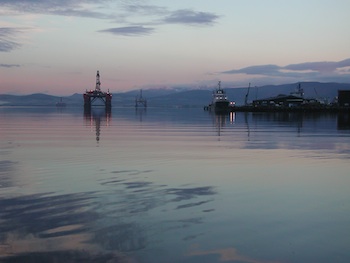
The Energy Day recently reported that there
were 12-14 rigs in the Cromarty Firth and that the number was shortly to
increase, and ever since Mr Brown announced the new oil tax the predicted
number of exploration rigs in the Cromarty Firth has been predicted as being
20. The current total number of rigs
in the Cromarty Firth is six, although there are also a couple in Belfast a
couple in Rotterdam and four in Norway. Of course we have never actually
used the total in Europe as a yardstick to measure the state of the oil
industry, so is this different, or have there always been a few rigs which
no-one wants, or which are undergoing major upgrades. When things were
humming and as a consequence several rigs were in the throes of major
upgrades did anybody consider the effect on the market if they were brought
back into play. Is the fact that the average day rate for a rig move
is now £11,000 and this time last year it was £24,000 due to the fact that
things are not as busy as they were last year, or due to the fact that a
large number of vessels have arrived on the market.
But we try not to discuss money. Its easier
to deal with the 10,000 year storm.
FOR INDEX OF NEWS AND VIEWS CLICK
HERE |
|
| |
|