|
THE VICTORY ET AL
I am starting this
newsletter with the intent of describing and commenting on nothing of any
importance, except what I experienced on my holidays, which since I live in
Spain, were in Britain, and I am including the photos because otherwise it
will make no sense.
First
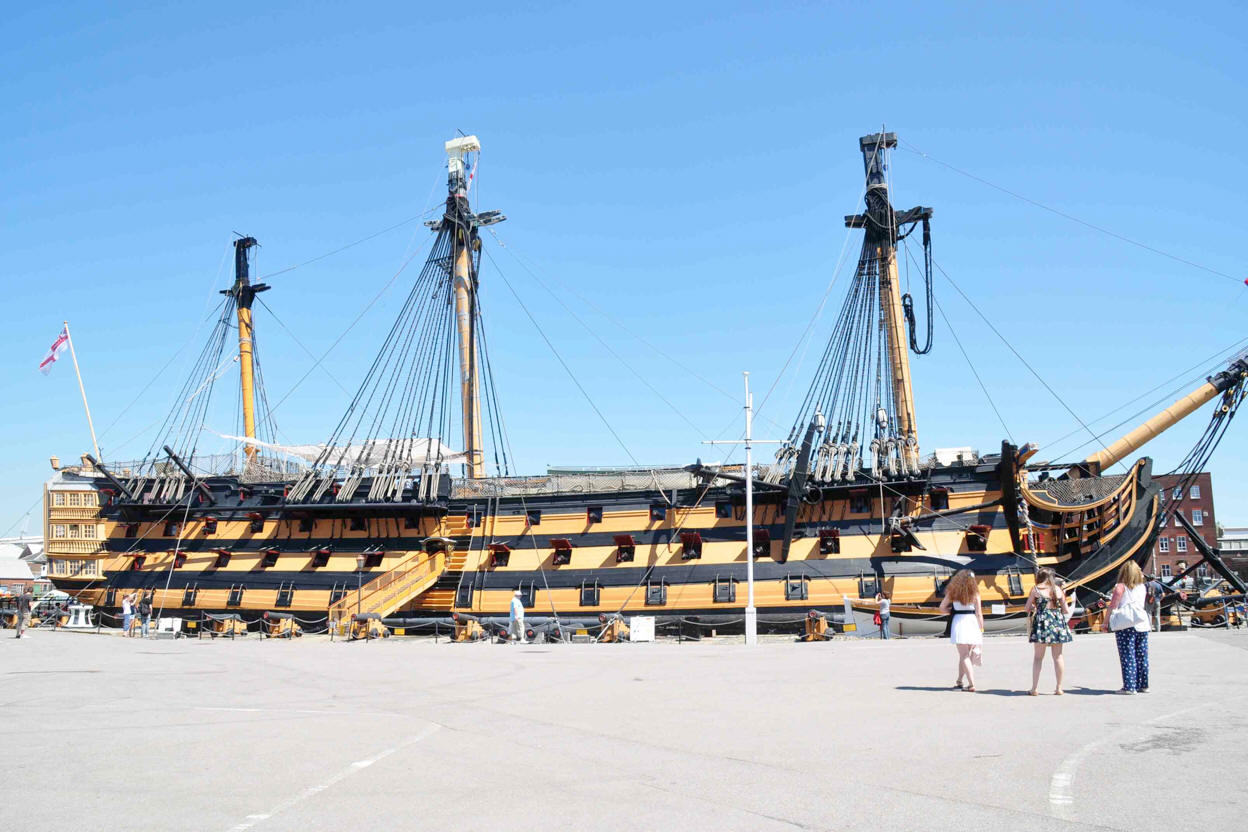
on the list is HMS Victory which is the oldest commissioned warship in the
British Royal Navy. It has been in its current drydock in the Portsmouth
naval base since 1927. I realised that despite my lengthy service at sea,
and my remaining enthusiasm for all things nautical I had never visited the
Victory. Even when I spent a summer working out of the port I still had not
taken to time to make a visit. This was, in a way, due to my lack of
enthusiasm for the age of sail, which has changed a bit since I read about
the amazing seamanship exhibited by the captains of these ships when they
went into battle. If one ship was dismasted another would take it in tow, so
that when they sailed past an enemy that vessel would receive broadsides
from two ships instead of one.
I had not ever thought about the masts and rigging of the ship until I
looked at this photo, and it is obviously missing its topmasts. You would
think that sometime in the last 100 odd years they might have replaced them.
And I was a bit surprised by the lack of symmetry in the disposition of the
main mast. The large spacer between it and the foremast was required so that
they had somewhere to stow the small boats, and was more or less standard
for the warships of the time.
If you go on board you can see the spot where Nelson fell after being shot
by a sniper on the French 74 gunner Redoubtable. But despite this it is not
the most exciting ship in the dockyard.
THE MARY ROSE ACCIDENT
The Mary Rose was recovered from the
seabed in the Solent in 1984, and might be Britain’s earliest catalogued
marine accident. It was built in 1510, and was the first warship to be
fitted with large guns, earlier vessels relying on marksmen in the fore and
after castles, and finally on hand to hand combat.
In order to keep the ship stable it was
felt that the guns should be set quite low down, and the new carvel
construction technique allowed the gun ports to be made watertight. However,
when the ship sailed on its maiden voyage the ports were opened to fire a
salute, and no-one remembered to close them afterwards. A witness statement
suggests that when the sails caught the wind the ship heeled over, and the
lower deck was flooded through the ports. The ship continued to heel over,
capsized and sank. Oh dear that again!
THE WARRIOR

Back in 1987 I spent the
summer as mate of car ferry, running between Gunwharf in Portsmouth and
Fishbourne on the Isle of Wight. Each trip across took 45 minutes and we
spent half an hour or so unloading and loading the cars coaches and
passengers at each end. The ships were powered by three Voith propellers,
two at the stern and one in the bow, a configuration which allowed them to
be propelled in any direction. While on passage a helmsman took the wheel
which operated the two props at the stern in a way which allowed it to be
steered in a conventional manner.
When we had cleared Portsmouth Harbour and approaches we would give the
order to the helmsman to head for “The Trees” and he would set course for a
bit of barren hillside. When I asked why this particular order, the answer
was that there used to be trees on top of the hill. When we headed into
Portsmouth Harbour we would give the order “Foudroyant” and the helmsman
would head for an old wooden warship well up in the anchorage. During my
period of employment there the Foudroyant was loaded onto a barge and towed
away to be restored, leaving an empty space up the harbour. We still told
the helmsman to head for Foudroyant, and the man would steer for the empty
space.
But, getting to the point, one day when we were going about our day to day
activities, churning back and forth across the Solent another barge hove
into view, this time with the British navy’s first powered warship, the
Warrior, on board. Over a day the barge was submerged and the warship
floated off and made fast in the dockyard, and I admit, I never gave it
another thought.
When I was talking to a friend before our holiday I said we were probably
going to the dockyard and he said what a great day out it was, but that he
had not managed to visit the Warrior. So, OK maybe it was not so special I
thought, but when we bought tickets we could see the Warrior tied up at the
closest berth, so we thought we might as well start there.
I only afterwards have found out something about the ship, and how it comes
to be, in my view, the star attraction in the dockyard. It entered service
in 1861 and was active for twenty odd years, but never saw action. It was
quickly outclassed by later warships fitted with thicker armour and rotating
turrets and so the Navy attempted to sell it for scrap. No-one wanted it
though and so it became the HMS Vernon torpedo school in 1904.
In 1929 further attempts to sell what had now become a hulk were also
unsuccessful, and so now dismasted and defunnelled, it was converted into a
refuelling pontoon and sited Milford Haven. In 1979 it was rescued by what
is now the Warrior Preservation Trust, and towed away to Hartlepool for
restoration.
The restoration was breathtakingly detailed, and every aspect of the ship is
probably just as it was in 1861 when it entered service. All the guns are in
place, including the ones in the junior officers cabins, taking up most of
the floor space. All the mess tables are present together with their
standard issue plates, knives forks and spoons, and all the firearms are
racked and the swords and cutlasses stowed. It is possible to see how the
sailors were divided up into 18 man groups, each responsible for its own
feeding and cleaning, thus relieving the higher echelons from such
responsibilities.
 The
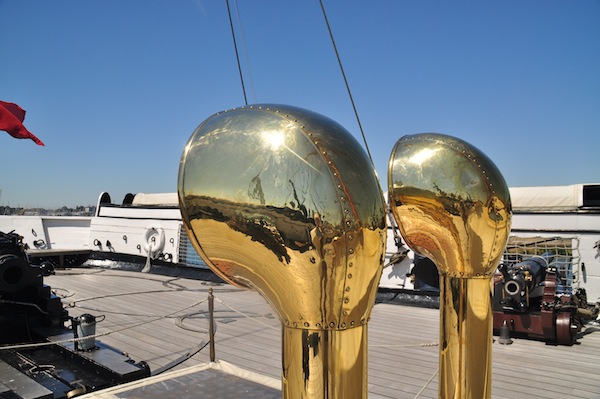
boilerroom is vast, the bunkers having a
capacity of 850 tonnes. Some thing I noticed was the fact that water was
contained in tanks with sounding tubes at various points on the deck, as
opposed to the Victory, which carried its water in barrels. What were they
thinking! The
boilerroom is vast, the bunkers having a
capacity of 850 tonnes. Some thing I noticed was the fact that water was
contained in tanks with sounding tubes at various points on the deck, as
opposed to the Victory, which carried its water in barrels. What were they
thinking!
Not only was the
Warrior restored, it continues to be maintained in the same state in which
the 600 odd sailors would have originally kept it.
THE CANTON
On 4th August my wife and
I had lunch with the man who had in 1962 been Third Mate on the P&O
passenger ship Canton. The painting was done by the man who had been my
fellow apprentice on the ship. We have all gone our different ways, and the
4th August was the first time the former Third Mate and I had met since the
ship had arrived back in the Royal docks, at the end of its last passenger
carrying voyage.
My fellow apprentice and I had gone on to join the first Oriana, but the
Third Mate had been one of the dozen or so officers, and twenty odd Indian
crew who had taken the ship to Hong Kong to hand it over to a scrap
merchant.
They had suffered from a particularly authoritarian master who seemed to
have had the impression that the passengers were still on board, and in the
end a few of the crew remained while a typhoon swept through Hong Kong and
waves broke over the deck. This, because the buyers refused to hand over the
cheque in case the ship was to sink.
The Canton, painted by Neil Martin
THE JAMES BOND EXHIBITION
While in London we took
the opportunity of going to the 007 Style Exhibition at the Barbican which
was quite good fun. They had lots of the actual stuff and the clothing used
in the films, and showed the relevant clips on large screens. I admit I was
hoping that in the “Boats” section they would show the sequence in “From
Russia With Love”, in which I took a small part. They did not, nor did they
show anything from Live and Let Die which surely featured the most
spectacular boat chase ever. So to make up for their omission I include a
screen shot featuring James Bond escaping in the white boat, while the
villains in black boats are about to be incinerated. I was in the black boat
closest to the flames. This was not CGI. The fire was created by blowing up
bags containing hundreds of gallons of petrol. It was hot!

LAKE CRUISERS
For those who want to go
on old marine craft and be transported from one place to another there is no
better place to go than the English lakes. The boats there do not suffer
from the corrosive effects of salt and so just seem to go on and on.
There are a couple of steamers on Lake Windermere and more on Ullswater, and
they have been there since Victorian times. This may be what is charming
about them. There is little more to do in the English lakes than go on boat
trips, go on bus trips, go on train trips and walk. It is what the Victorian
did, and it is what you do now if you go there. We might possibly add
“waiting for the rain to stop”, since the lakes are well known for bad
weather, but this can be done in public houses (bars for none UK readers),
where the standard of the beer has improved beyond recognition in the last
twenty years or so.
Also on Windermere there are a number of motor driven wooden boats, doing
short runs across the lake, one of which is the “Queen of the Lake” -
pictured - which was transported to London recently to take part in the
Queen’s Jubilee celebration as one of the 1000 craft in the Thames Pagaent.
INFORMATION ABOUT THIS NEWSLETTER AND SHIPS AND OIL LTD
This newsletter expresses the views of the author Victor Gibson about marine
events which are considered to be worthy of interest. It is meant to be a
five minute read. Sources of information usually include:
International Tug and OSV Magazine
Maritime Bulletin
The Tugs, Towing and Offshore Newsletter.
The Nautilus Telegraph
The Nautical institute Magazine Seaways
The BBC Home Page
The Somalia Report
The MAIB Website
Although this time the information relies solely on what I did on my
holidays. There is more actually but I had to draw the line somewhere. Back
to normal next month.
The website contains comprehensive information about many offshore vessels
and approaching 10,000 images. Since June 2012 the following company
information has been updated as follows:
Acergy
Acomarit
Active
Adams Offshore
AET Offshore
Alam Maritim
Allied Marine
Alpha Logistics
No further updating has been carried out in the latter part of July and the
early part of August because I have been away, but I read that there are
more an more owners of offshore vessels appearing on the scene. Where will
they get their crews? Maybe they will get them from the many Brazilian
seafarers who send me their CVs in the hope of gaining employment. I have
emailed one or two asking why, but they either don’t know or don’t choose to
tell me.
There have also been almost no Pictures of the day, although people have
continued to send them, for which I am very grateful. The photos brighten
the days of our hundreds of visitors as they sit at their desks – I have
noticed that our numbers are considerably reduced at the weekends.
SHIPS AND OIL OFFERS THE FOLLOWING PUBLICATION FOR SALE ON ITS WEBSITE:
THE HISTORY OF THE SUPPLY SHIP £37.50 inc P&P anywhere
SUPPLY SHIP OPERATIONS £27.50 inc P&P anywhere
RIGMOVES £5.75 inc P&P anywhere
SEE THE WEBSITE FOR MORE INFORMATION.
Buy all three books for the bargain price of £52.50
Vic Gibson. June 2012.
If you would like to
receive News and Views as a PDF - with photos -
email me.
FOR INDEX OF NEWS AND VIEWS CLICK
HERE |


_small.jpg)

.JPG)