|
RIGMOVES
Having made the offer of a
free gift of my novel "RigMoves" in the December news and views, I was
disappointed when only four people took up the offer. There were and are no
strings attached. There is no requirement to provide banking details or
passwords, and the email addresses necessarily used to ask for the book to
be sent will not be used for anything at all.
So does this mean that
only a few people are attracted by the book, despite its slightly nautical
associations, or is it more likely that not many people read news and views?
On the plus side one or two people have chosen to pay for the book, which
incidentally only costs £5.75 including P&P.
So
now, in January 2012 there are still six copies of RigMoves available free.
My wife has pronounced it "well written", even though she is not a science
fiction fan, and actually not a fan of my written work. She generally enjoys
more cerebral stuff, and let's face it, most of what I write is pretty
lightweight and is mostly intended to provide a bit of entertainment.
So if you would like a
copy just email me at
sales@shipsandoil.com - quoting
the reference NV1211, with your address.
As of 18th January down to
two free offers. But I'm told it's worth £5.75!!
RIG MOVES
Those of us who like to
follow the movements of what are usually North European mobile units are
aware that the now famous Ocean Guardian which has had such terrific success
for Rockhopper is due to leave the Falkland Islands and return to the North
Sea in March. It's a long trip and one wonders what sort of negotiations
have been carried out by both Diamond and the interested party who has hired
the rig. For instance, is the new client going to pay for the relocation of
the unit from the other end of the world, particularly when another Earl
and Wright 700 series (The Sedco 712) is currently cold stacked in the
Cromarty Firth? Of course many operators are loath to take on rigs that have
been cold stacked. It is a real pain to get them going because machinery
does not like being left idle and new crews take time to get used to the
rig, and the work to be done. Of course the tanker business has
traditionally got over this problem by operating at a small loss rather than
laying up their ships, but rig owners are reluctant to do this in case of a
"train wreck". I used to wonder what they hell they meant by this before the
Deepwater Horizon accident.
Meanwhile as one rig is
preparing to depart Falklands waters another is arriving. The Ocean Rig rig,
Leiv Eiriksson left the Arctic at the beginning of December and set off for
the Falklands where it is due to drill a couple of wells for Borders and
Southern. The offshore press has also reported that the rig will be
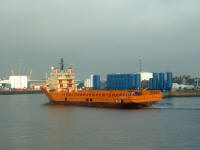
supported by the Sartor standby vessel Ocean Prince and the PSVs Toisa
Sonata and Toisa Intrepid. Of course the Leiv Eiriksson is a DP rig and
therefore does not need any anchor-handlers to put it on location.
_small.JPG)
The Toisa Intrepid
The Ocean Prince
THE LOSS OF THE KOLSKAYA
Sadly yet another jack-up
has sunk under tow. On 18th December in the Sea of Okhotsk the Kolskaya
began to take on water and sank in adverse weather. Only 14 of the 67 people
who were on board were saved. The rig was owned by the Russian company
Arktikmor Neftegaz Razvedka (AMNGR) and was built in 1985 at Rauma Repola in
Helsinki. The company owns another jack-up, a drill ship, a diving ship and
four AHTS one of which is the Aldoma.
There is currently limited
information available in English about what happened, but at the very least
the weather got up unexpectedly, the rig started to take on water and
unexpectedly took on a list and then sank. It appeared that to start with
the crew assembled in two groups and waited expectantly for
helicopters to evacuate them. Then they were told that there would be no
helicopters, but did not have time to get in the lifeboats before the rig
heeled over and dumped them all in the water. An investigation is apparently
taking place.
This is just the latest of
a long list of jack-up losses, and if one looks through the building list
for Le Tourneau you can see that about 40% of all the rigs built by the
company have sunk. Usually this things have very little freeboard when under
tow, and so it does not take really rough weather for waves to start to
mount the deck. Then, unless all the stuff on deck has been really well
secured , containers will start to move about and knock the tops off
ventilators. At times the seas will prise the hatch covers off the preload
tanks and they will start to fill up with water. After that it is just a
matter of time. Because of these problems it used to be accepted practice
for lifeboats to be removed from the davits and secured on deck - what! I
hear you say. Yes it's true. Also it is recommended that the number of crew
on board be minimised during moves, usually to the number which can be
fitted into one helicopter. However, this gives everyone problems and anyway
if all the crew are kept on board they can be doing maintenance while the
rig is on passage.
I doubt that we will ever
know the results of the investigation - or that there will be any lessons
learnt.
FISHING IN THE ICE
There have recently been a
couple of accidents to fishing vessels in Antarctic waters. First a Russian
ship, the Sparta, with more than 30 people on board was holed by an iceberg
on 16th December, and more recently a South Korean fishing vessel, the Jung
Woo 2, caught fire and sank with the loss of three lives and a number of
injuries due to burns.
The Russian ship was saved
from sinking after a New Zealand aircraft dropped two pumps on separate
occasions to help the ship regain its stability. Subsequently a South Korean
research ship forced its way through to the Russian ship and it was reported
that they had managed to install a cement box over the hole. Later it made
its way to New Zealand for more permanent repairs.
The Jung Woo 2 was in the
Ross Sea when it caught fire, and was assisted by two other Korean vessels
in the area, and later by the US research ship Nathaniel B Palmer. The
injured men were evacuated to the McMurdo Station Antarctic base and later
airlifted to New Zealand for treatment.
It sounds pretty busy down
there all things considered, but it appears from one of the news items
that the reason for the fishing vessels being there is the Toothfish, which
is interesting in itself. This fish, also known as the Chilean Sea Bass can
live to an age of 50 years and does not reach maturity until it is nine
years old. Its blood contains antifreeze and it can survive in water depths
of 5000 feet. It is apparently a luxury seafood, and hence the presence of
the fishing vessels in the Southern Ocean.
THE NOYDENA
The well known Seattle
shipbrokers Marcon International recently reported the sale of the pusher
tug Noydena. It was sold by Tidewater Barge Lines Inc and purchased by JT
Marine Inc of Vancouver. Nothing unusual about that then, you might think.
Marcon sell loads of vessels, and publish a very informative newsletter,
information from which I used in compiling my book "The History of the
Supply Ship".
But while Marcon don't
claim that this is the oldest vessel they have sold, the Noydena was
actually built in 1932. It has been called the "Jenny Barber", the "Chief",
the "Arrow No 4" and from 1962 has been known as Noydena - so fifty years
with the same name then. It is now to be called "Stacy T".
In October 1969 the tug
sank when the barge it was towing capsized and the upperworks were
demolished, but it was rebuilt and continued in service. It has also been
re-engined a couple of times and is now powered by two Cat D398s. In any
search for the oldest working ships in the world I would put forward the
Yapura, which is one of two gunboats built in UK for the Peruvian navy to
operate on Lake Titicaca in 1862. It now operates as a medical ship,
servicing villages round the lake. Its sister ship, the Yavari has been
refurbished and can be visited at Puno.
Vic Gibson. January 2012.
|


_small.jpg)

.JPG)


.JPG)